
You already know your customers are not just clicking an ad, filling out a form, and magically turning into revenue. They are moving through a series of moments with your brand, and each one either builds confidence or creates friction.
That series of moments is your customer journey.
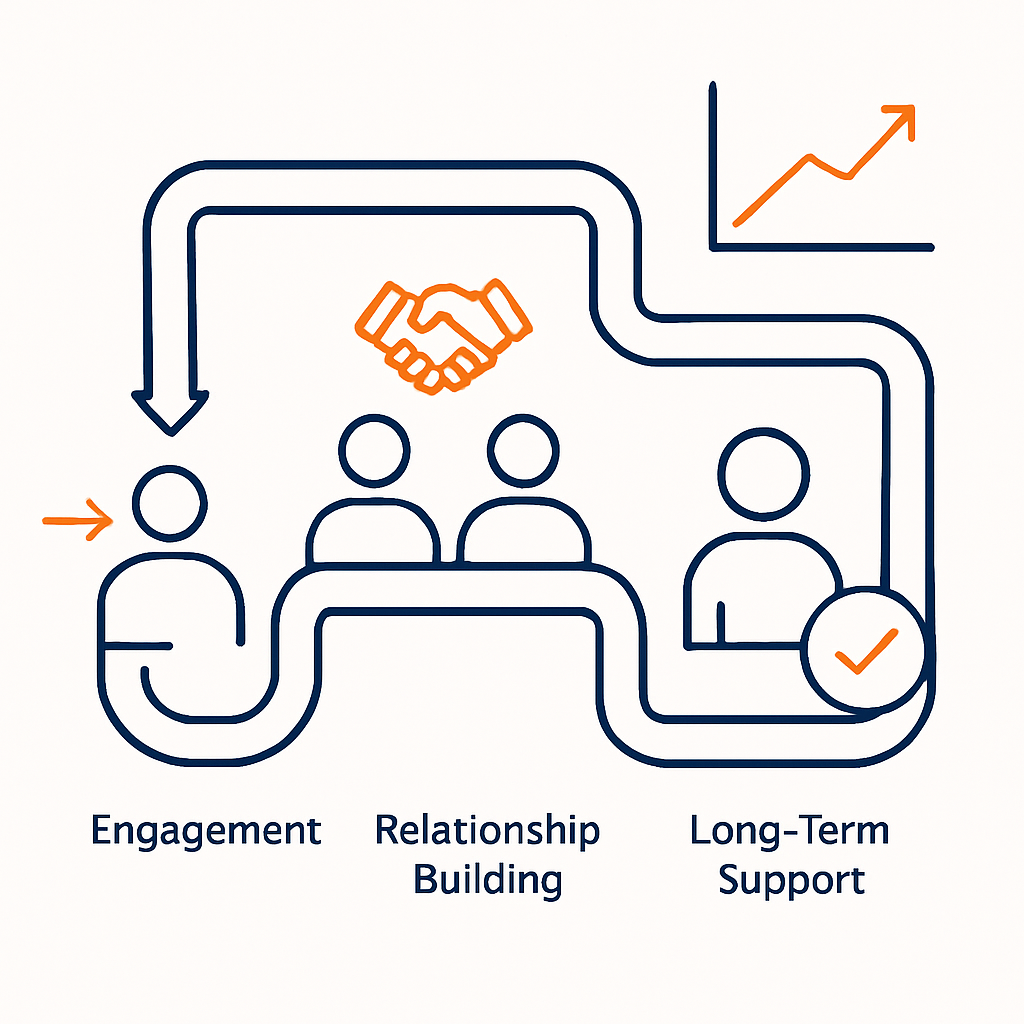
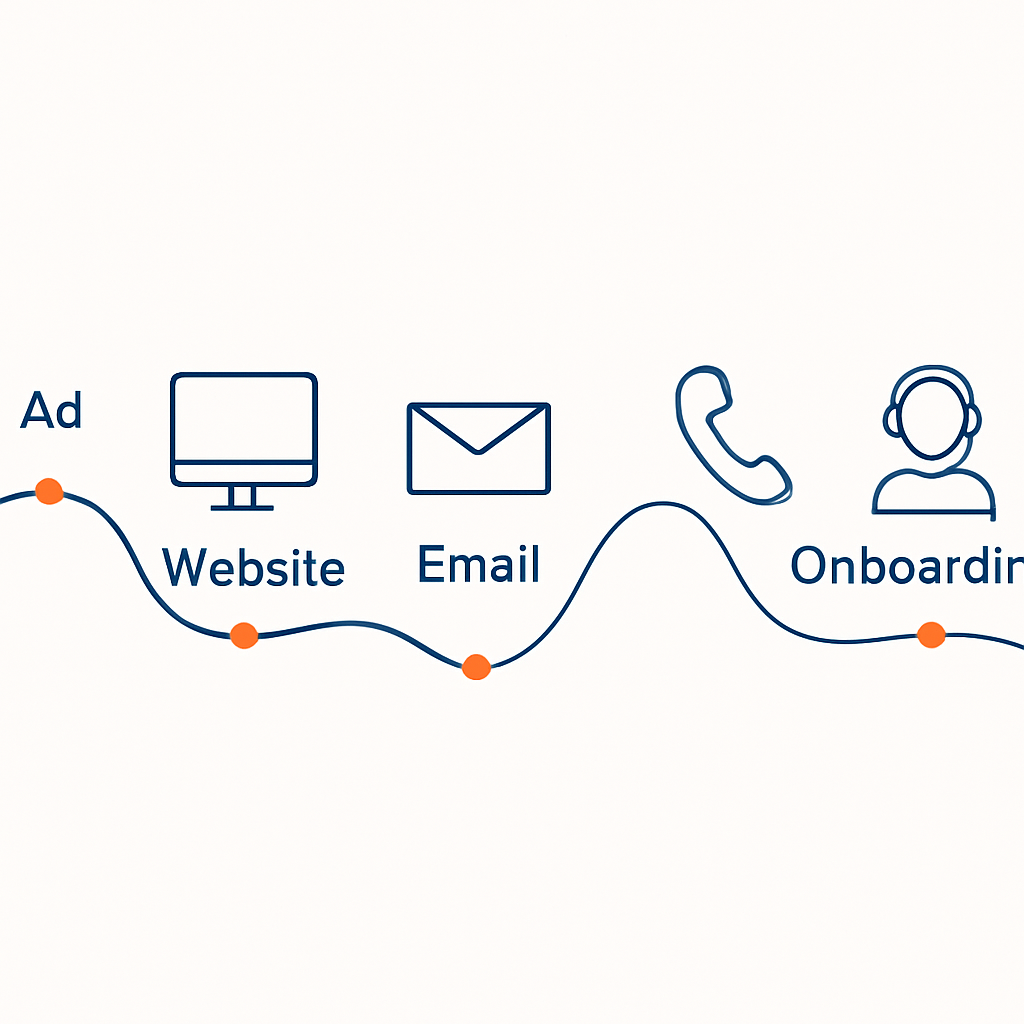
Think of it as the full path a person takes with your company. From the first time they see your name, to the research they do, to the emails and ads they get, to the sales calls, to onboarding, and every touch with support or success after they buy. Every channel, every message, every conversation is part of that journey.
As a marketing manager, you are stuck right in the middle of it. You see the ad copy, the email flows, the website, and usually some version of what sales is sending. You also see where it breaks. That is the real problem.
When the journey is inconsistent, everything gets harder.
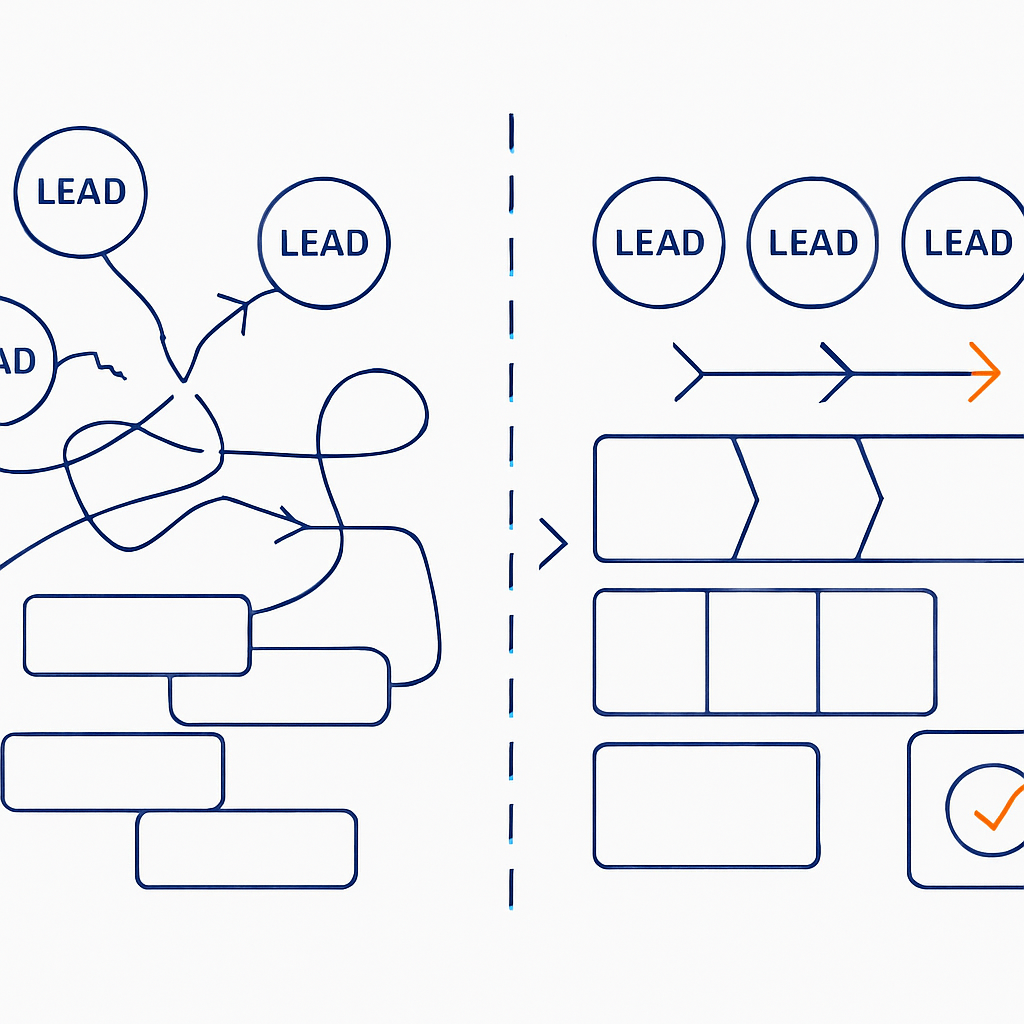
You feel it when one team sends a polished, helpful nurture email and another team hits the same lead with a generic sales pitch that ignores what they just downloaded. Or when the website promises one thing, the sales deck says another, and the onboarding team delivers something else completely. Same logo, different worlds.
On paper, your job is to drive engagement, pipeline, and revenue. In practice, you are trying to do that while different departments run their own version of the customer journey, with their own tools and their own priorities. The result is not just messy. It is expensive, and it quietly drags down your numbers.
What a “consistent customer journey” actually means
Consistency is not about making every email or ad look identical. It is about creating a journey where:
- The story stays the same, from first touch to renewal. Your positioning, promises, and value do not shift based on who is talking to the customer.
- The experience feels connected. Each touchpoint acknowledges what came before and sets up what comes next, instead of treating every interaction like a cold start.
- Every team knows their role in the journey and how their part connects to the rest, so the customer does not feel like they are starting over every time they move to a new stage or department.
- Data follows the customer. You are not asking the same questions in five different forms or sending irrelevant messages because no one can see a complete picture.
When that level of consistency is in place, the journey feels smooth to the customer and manageable to you. You know what they should see next, which message fits the moment, and where to troubleshoot when performance drops.
Without that consistency, you get noise instead of momentum.
Why consistency in the journey matters for your marketing results
If you are responsible for engagement, pipeline quality, and revenue influence, a consistent customer journey is not a nice-to-have. It is the base layer your performance sits on.
Here is why it matters so much to your world.
1. It shapes how prospects perceive your brand
Your campaigns might look strong in isolation. Ad creative is sharp, emails are on point, site content is solid. But a prospect does not experience those pieces in isolation. They experience them as one long conversation.
When that conversation jumps around, you create doubt. Doubt about what you really do. Doubt about whether you understand their problem. Doubt about whether you can deliver what you promise.
Inconsistent journeys train people not to trust your message.
That shows up as low engagement, slow deals, and constant pressure to “fix the top of funnel” when the real issue lives across the entire path.
2. It directly affects conversion and revenue potential
Every time your journey breaks, you make your prospect work harder. They have to repeat context. Reinterpret mixed messages. Figure out which offer is real. Identify who they should respond to.
The more mental work they do, the more likely they are to stall, ghost, or choose someone that feels clearer and more aligned.
When your journey is consistent, each touchpoint builds on the last. Leads are more qualified by the time they talk to sales. Sales can have a focused conversation instead of backtracking over basics. Post sale teams can reinforce promises instead of trying to reset expectations.
That is how consistency turns into higher conversion rates at each stage, even if your individual campaigns do not change much.
3. It makes your marketing data actually useful
If marketing tells one story, sales tells another, and customer success runs a different playbook, your numbers will always look fragmented.
- Attribution looks random, because touchpoints are not part of a unified flow.
- Channel performance is hard to compare, because the follow up sequence is inconsistent.
- Journey analytics are incomplete, because every team tracks their own slice in isolation.
With a consistent journey, you can map performance to specific stages, spot weak points, and know whether you have a traffic problem, a messaging problem, or a follow up problem. You stop guessing and start optimizing with intent.
Where inconsistent journeys usually show up for marketing managers
You probably feel this already, even if no one has named it. Inconsistent journeys tend to show up in the same patterns across teams.
Misaligned messaging across departments
Marketing uses one set of pain points and value props, sales leans on a different set, and product or support talks in a completely different language. Prospects hear shifting benefits and changing priorities depending on who they talk to.
You end up stuck in the middle, trying to please everyone, and it becomes almost impossible to run clear, consistent campaigns that tie to revenue.
Uncoordinated outreach and touchpoints
One lead fills out a form and then:
- Gets dropped into a nurture flow that does not match their real intent.
- Receives direct outreach from sales that ignores what they engaged with.
- Gets retargeted with ads that are two stages behind where they are mentally.
From the customer’s side, it feels like your company does not talk to itself. From your side, it looks like low response rates, “unqualified” leads, and a constant need to defend marketing sourced opportunities.
Fragmented tools and data
Marketing uses one set of platforms, sales uses another, support uses a third, and none of them really sync in a clean, practical way. That gap becomes a journey problem.
You cannot see a full view of what a contact has done. You cannot easily control frequency or sequencing across channels. You cannot enforce consistent standards because you are missing visibility into what other teams are sending.
This is why it feels like you are doing all the right things, but still not seeing clean, confident results.
You are not just fighting for budget or better creative. You are fighting the drag created by an inconsistent customer journey that crosses multiple teams, tools, and priorities.
The good news is this can be fixed in a structured way. You can bring consistency to the journey without trying to control every department. The rest of this guide will walk through the hidden costs of the inconsistency you are dealing with, then show you how to diagnose it, align teams, map the journey, and build processes that keep it consistent over time.
The Hidden Costs of Inconsistent Customer Journeys
You already feel the pain of inconsistency in the journey. What usually gets missed is how expensive it really is. Not just in vague “brand impact” terms, but in real, daily costs that drag down your numbers and your credibility.
Inconsistent journeys tax your customers, your team, and your budget at the same time.
Let’s break down where that cost shows up, so you can name it and address it instead of just absorbing it.
Customer confusion that quietly kills momentum
A confused customer does not move forward. They stall, they delay, or they disappear.
Inconsistency creates confusion in ways that are easy to miss from the inside:
- Mixed promises, where marketing talks about one main outcome, sales pushes a different benefit, and the product experience reinforces something else entirely.
- Conflicting offers, where a prospect sees different pricing, timelines, or calls to action depending on which channel they touch.
- Shifting narratives, where your “why us” story never sounds the same twice across paid, email, and sales conversations.
From the customer’s perspective, it stops feeling like one company having a clear conversation. It feels like multiple disconnected brands fighting for their attention under a single logo.
Confusion is a cost, and it usually shows up as stalled deals and passive disengagement.
Diminished brand trust that is hard to win back
Trust is not only about product quality. It is about whether your message holds up from one touchpoint to the next.
When the journey is inconsistent, prospects start to question:
- If you understand their problem or are just guessing.
- Which version of your promise is the real one.
- Whether the post sale experience will match what was sold to them.
That doubt does not always show up as explicit objections. It shows up as lukewarm calls, low reply rates, and “we are going to pause for now” feedback.
Once people sense your story does not hold together, it is much harder to rebuild that trust later in the journey. You may need heavier incentives, longer nurture cycles, and more touches just to get the same result a clear, consistent journey could have produced earlier.
Trust lost to inconsistency is one of the most expensive things you pay for, because it rarely shows up as a direct line item.
Lower engagement that makes every channel look worse than it is
If each department runs its own disconnected version of the journey, engagement metrics across your channels will look weaker than they should.
For example, you might see:
- Strong early interest, followed by sharp drop offs when messaging shifts tone or focus between stages.
- Decent open or click rates, but very few meaningful replies or conversions, because the follow up sequence does not match what came before.
- Retargeting that chases people with irrelevant creative because it is not aligned to their current stage in the journey.
This is where you start to get pressure around “improving campaign performance” when the real leak is the handoff, not the channel.
Inconsistent journeys make good campaigns look mediocre, and mediocre campaigns look like failures.
That hurts your ability to argue for budget, defend your strategy, and prioritize long term initiatives over short term band aids.
Lost sales opportunities that never show up in your reports
Some costs are visible. Others just never appear in your pipeline at all.
Inconsistent journeys create invisible loss in a few specific ways:
- Missed timing, where a prospect is ready to talk, but receives content aimed at a much earlier stage, so they disengage and choose a competitor that feels more aligned.
- Overwhelming outreach, where multiple teams contact the same person in different ways, so the safest move for that person is to ignore everyone.
- Under qualifying leads, where the journey does not educate or frame the problem well enough, so sales spends time on the wrong prospects while better fit leads slip away.
You will not see these as “lost opportunity” in your CRM, because many of these people never get far enough into the process to be counted. They just drift out of your orbit.
That is a real cost, and it piles up every month the journey stays inconsistent.
Internal inefficiencies that burn time and energy
The cost is not only external. Inconsistent customer journeys create a constant drag inside your organization, and you feel it in your day to day work.
Here is what it often looks like for marketing managers:
- Redoing work, because each team tweaks messaging, decks, and assets on their own, instead of building from a shared source of truth.
- Answering the same questions repeatedly, since sales, support, and leadership all see different slices of the journey and keep coming back for clarification.
- Running reactive fixes, like emergency nurture flows or ad updates, because misalignment elsewhere breaks the experience midstream.
All of that is lost time you could have spent on strategic projects. Journey audits. Better segmentation. Testing higher quality offers. Planning multi touch campaigns. Instead you are stuck playing clean up for inconsistency you did not create.
Internal friction is a cost center, and it grows in direct proportion to how fragmented your customer journey is.
Wasted budget and misallocated resources
When the journey is not aligned, spend rarely maps cleanly to outcomes. You put money into activities that cannot perform at their potential because the downstream experience is misaligned or broken.
That usually looks like:
- Investing in top of funnel channels while mid funnel messaging sends people sideways.
- Paying for tools that duplicate functions across teams but do not share data in a way that improves the journey.
- Launching campaigns that drive leads into pipelines where follow up sequences are outdated or out of sync with current positioning.
When leadership questions why results do not match investment, the answer often lives in the journey, not the budget. If spend feeds an inconsistent path, you are scaling the chaos, not the impact.
Every dollar that pushes people into a broken or disjointed flow is a dollar working against you.
Misalignment that undercuts your strategic role
There is one more cost that hits you personally. When the journey is inconsistent, marketing looks like a support function instead of a strategic driver.
Here is why.
- Sales and leadership see fragmented journeys and assume the problem is “bad leads” or “weak messaging”, so they treat marketing as a service desk for quick fixes.
- Customer facing teams have to improvise around inconsistent messaging, so they create their own materials and processes and drift further away from your strategy.
- You spend more time justifying or explaining your work than using your skills to improve the full customer experience.
Inconsistent journeys do not just hurt performance, they limit your influence inside the company.
The more fragmented the path, the harder it is for you to show clear cause and effect between strategy, journey, and revenue. That is what keeps you in reactive mode instead of being seen as the person who owns and steers the customer experience across teams.
You do not have to stay stuck in that pattern. Once you can clearly see these hidden costs, you are in a better position to call them out, get buy in, and start raising the standard for what a consistent journey should look like. Next, we will look at how inconsistency shows up directly in the customer experience and why it hits engagement and conversions so hard.
How Inconsistency Impacts Customer Experience and Engagement
When the journey is inconsistent, customers feel it long before you see it in your dashboards. The experience gets messy, their patience drops, and your engagement numbers quietly follow.
You are not just dealing with a “messaging problem”. You are dealing with a user experience problem that cuts straight through your nurture flows, your conversion rates, and your ability to move anyone from interest to decision with confidence.
What inconsistency feels like from the customer’s side
Inside your company, it looks like disconnected tools and siloed teams. From the customer’s side, it feels like this:
- Mixed messages that change tone, promise, or focus from one touchpoint to the next.
- Disjointed interactions where each new email, ad, or call ignores what happened before.
- Repetitive questions that force them to repeat the same information to different people.
- Jarring handoffs where the shift from marketing to sales or from sales to post sale feels like walking into a different company.
None of that is dramatic on its own. The problem is the accumulation. Every small disconnect adds friction, and friction is what kills momentum.
If the journey feels chaotic, people protect their time and attention by disengaging.
Mixed messaging and the frustration it creates
Mixed messaging is usually the first thing a prospect bumps into.
They see one angle in an ad, a different angle on the landing page, and then get an email that talks like you are solving another problem altogether. They are left doing the work of trying to connect the dots.
Here is how that frustration shows up in practice:
- Cognitive overload. When your message keeps shifting, prospects have to keep recalculating what you do, who you serve, and why it should matter to them. That is work, and busy people avoid extra work.
- Perceived lack of focus. If you show up with a new angle every time, it signals that you are not clear on your own strengths. That is a trust hit before you have even had a proper conversation.
- Higher skepticism. When one touchpoint promises big strategic value and the next talks like a low level feature, people start wondering which version is real.
Once someone is frustrated or skeptical, your nurture content has to climb over that emotional barrier just to get back to neutral. That is a steep cost for something that is completely avoidable with a consistent narrative.
Disjointed interactions and broken momentum
Disjointed interactions are what happen when each touchpoint behaves like a first date, instead of a continuation of the same conversation.
For example, the journey might feel like this to a prospect:
- They fill out a form for mid funnel content, then receive top of funnel “awareness” emails that ignore their existing knowledge.
- They book a call, then talk to a rep who has not read their form responses or previous interactions.
- They complete a demo, then get hit with generic nurture messaging that treats them like a cold lead again.
The pattern is simple. They move forward, your journey pulls them backward or sideways.
Every time you reset the conversation, you lose momentum.
Momentum is what turns attention into genuine interest, then into commitment. When the journey does not acknowledge where someone is mentally, that momentum breaks. People start to feel like you are wasting their time, so they protect themselves by pulling away.
How this wrecks lead nurturing in practice
On paper, your nurture strategy probably looks clean. You have stages, segments, and a sense of what you want people to see next. In reality, inconsistent journeys scramble that structure.
Here is what that looks like inside your nurture funnel.
1. The wrong message hits at the wrong time
If the journey is not aligned across departments, it is very easy for people to receive:
- Introductory content when they are ready for decision stage detail.
- Bottom of funnel offers when they are still trying to understand the basics.
- Feature comparisons before they even believe in the core problem you solve.
When timing is off, good content falls flat. The message itself might be solid, but if it does not match where they are in their thinking, it feels irrelevant or pushy.
That leads to lower engagement in nurture flows and forces sales to work harder to rebuild context on live calls.
2. Nurture feels like spam instead of support
Nurture is supposed to feel like helpful guidance. Inconsistent journeys turn it into noise.
People get hit from multiple directions with content that does not line up. A marketing email talks about one use case, retargeting shows another angle, and a sales follow up reaches out with a third narrative.
From their inbox and browser, it looks less like a helpful brand and more like a crowded inbox that can be cleaned up with one click on “unsubscribe”.
Once your nurture is perceived as noise, you lose the right to keep showing up.
That is when unsubscribe rates creep up, reply rates stay flat, and you are pushed to “freshen” campaigns that are not the real issue. The issue is the fragmented journey around those campaigns.
3. Lead quality appears worse than it actually is
When nurture flows do not build on each other cleanly, you get a distorted view of lead quality.
- Leads look “cold” because they stop engaging after the first disconnect in the journey.
- Sales assumes marketing is sending weak leads, because conversations feel disjointed and unqualified.
- Marketing assumes the audience is not a fit, when in reality the experience simply did not earn their sustained attention.
Inconsistent nurture can turn strong leads into silent ones. It is not that they were never interested. The journey just gave them too many reasons to step back.
The direct hit on conversion rates
All of this lands in the same place, your conversion numbers.
Every mixed message and disjointed touchpoint adds friction at key decision moments. Here is how that usually plays out across the funnel.
Top of funnel: fewer people move from interest to intent
At the awareness stage, inconsistency shows up as a mismatch between the first promise and what comes next.
Someone clicks an ad or social post because the hook resonates. Then they hit a landing page with different language and a different focus. That disconnect is often enough to keep them from opting in or taking the next step.
You pay to generate clicks, but a portion of those people drop right there because the journey does not feel coherent.
Mid funnel: stalled evaluations and ghosted conversations
Once people are in your world, inconsistency during evaluation is where a lot of hidden loss happens.
- Prospects get conflicting information from content and sales, so they delay making a call.
- Decision makers receive decks or follow ups that do not match the narrative their team originally bought into.
- Key questions go unanswered, because each touchpoint assumes another part of the journey already handled it.
This is where “we need more time” or “we are going to revisit this later” comes from in many cases. The friction is not always your price or feature set. It is the feeling that the journey did not give them a clean path to yes.
Bottom of funnel: last minute doubt and second guessing
At the decision point, prospects are looking for alignment.
They want the proposal, the contract, and the onboarding conversation to sound like the same company that spoke to them at the start. If something feels off, they hesitate.
When the journey is inconsistent at this stage, you see:
- Last minute objections that trace back to unclear or conflicting expectations earlier in the journey.
- Internal champions losing confidence because they cannot clearly explain your value to their stakeholders anymore.
- Deals dragging on while prospects compare you with alternatives that feel more straightforward and consistent.
Doubt at the last mile is expensive, and inconsistency is one of the fastest ways to create it.
Why this matters so much to your role
As a marketing manager, you own a big chunk of the journey, but you do not control all of it. That is where the frustration comes from.
Inconsistent experiences turn into:
- Engagement metrics that undervalue your best work.
- Nurture funnels that look weak because the surrounding journey is broken.
- Conversion rates that stall for reasons you cannot see in your own tools.
You feel pressure to fix what is in your direct control, campaigns, content, automation, targeting. Those are worth improving, but they will always underperform if the journey around them is not consistent.
The next step is to spot where inconsistency is creeping into your own organization, so you can address the experience at the source instead of chasing surface level symptoms. That starts with knowing what signs to look for across teams, channels, and stages of the journey.
Identifying Signs of Inconsistent Customer Journeys Within Your Organization
You already know something is off. The numbers feel softer than they should, sales has one story about “lead quality”, and your campaigns never quite get the clean run they deserve. That is usually not a media problem. It is a journey problem.
Your first job is not to fix everything. Your first job is to spot the signals that your customer journey is inconsistent, so you can name them and point the organization toward the real issues.
If you cannot see the inconsistency clearly, you will keep trying to solve it with more campaigns and more tools.
The four big categories of warning signs
You can think of journey inconsistency in four main buckets:
- Conflicting messages across marketing, sales, and post sale teams.
- Duplicate or uncoordinated outreach to the same contacts.
- Missed or weak touchpoints at key stages in the journey.
- Inconsistent content and branding across channels and assets.
Once you start looking through that lens, the patterns become obvious very quickly.
1. Conflicting messages between teams
This is the symptom most marketers feel first. You work hard to position the product one way, then find out other teams are telling a different story.
Common signals include:
- Different “main problems” described, where marketing talks about one central pain, sales leans on another, and support frames issues in a completely different way.
- Shifting value props, where your website, sales deck, and onboarding materials each highlight a different “core benefit”.
- Inconsistent promises, where timelines, outcomes, or scope sound more aggressive in early stage messaging than what delivery or support can actually sustain.
You can confirm this quickly by doing a simple internal comparison.
- Pull your homepage headline, your primary paid ad headline, your main sales deck headline, and the first slide or section from onboarding materials.
- Ask one clear question of each item, “What problem are we saying we solve?” or “What outcome are we promising?”
- If those answers do not match, you have messaging inconsistency baked into the journey.
When the story keeps shifting by department, customers feel like they are talking to different companies that share a logo.
2. Duplicate outreach and channel chaos
If you have ever cringed at a thread where three different people from your company emailed the same prospect for different reasons, you have already seen this one.
Signs of uncoordinated outreach include:
- Multiple teams contacting the same person within a short window, each with their own agenda and no reference to the other touchpoints.
- Prospects replying with confusion, for example, “I am already talking to someone else from your company” or “I just had a demo, why am I getting this?”.
- Channel frequency that feels excessive, such as someone getting nurtured by email, retargeted aggressively, and contacted by sales, all triggered separately with no shared logic.
A simple way to test for this is to run a single contact journey review.
- Pick a handful of recent contacts, across a few segments.
- Look at every touch they received from marketing, sales, and success over a set timeframe, for example, the past [insert number] days.
- Ask yourself two questions:
- “Would this feel like a coordinated conversation if I were them?”
- “Is there any point where I would feel annoyed or confused by the volume or content?”
If the answer is “no” and “yes” more than once, you have an outreach consistency problem, not just a list or sequencing problem.
When outreach is not coordinated, the journey feels noisy instead of intentional.
3. Missed or weak touchpoints at key moments
Sometimes the issue is not what you send. It is what you do not send at all.
Inconsistent journeys often have entire gaps where no one owns the experience, so prospects or customers are left to figure things out alone.
Signals to watch for:
- Leads that go cold after a form fill, where people convert on a high intent action, then either get a generic nurture or no relevant follow up.
- Silence between stages, for example, a long gap between a discovery call and proposal, or between contract signature and onboarding.
- No proactive communication around common friction points, such as pricing questions, implementation worries, or internal stakeholder alignment.
A practical way to uncover these gaps is to do a stage by stage touchpoint audit.
- List the major stages of your journey for one primary segment, for example:
- First awareness
- Initial interest
- Active evaluation
- Decision
- Onboarding
- Early usage
- Under each stage, list every touchpoint a contact reliably receives today, not what you intend, but what is actually configured or practiced.
- Look for stages with:
- Only one touchpoint, or none.
- Touchpoints that do not reference what came before.
- No clear owner, for example, no team feels responsible for that part of the experience.
Those are your missed or weak touchpoint zones. They are often where the journey feels disjointed or where momentum quietly dies.
If no one owns a stage, your customer will feel that, even if they never say it directly.
4. Inconsistent content and branding across channels
This one is easy to spot visually, but it runs deeper than colors and logos.
You are looking for any place where your content or brand feels like it was created by separate companies that do not talk to each other.
Red flags include:
- Different tone of voice across your site, emails, ads, and sales collateral. For instance, one channel sounds sharp and clear, while another sounds stiff or generic.
- Old versus new positioning in circulation at the same time, where some teams still use outdated taglines, messaging, or visual styles.
- Fragmented asset quality, where some decks, one pagers, or knowledge base articles feel polished and current, while others feel like legacy scraps people keep reusing.
A quick content consistency scan helps here.
- Collect a small set of assets from each major channel:
- Home or key landing page
- Top nurture email
- Primary sales deck
- Onboarding or support documentation
- One or two retargeting ads
- Look at them back to back and ask:
- “If I saw these without logos, would I know they are from the same company?”
- “Does the same core message and personality show up in all of them?”
If the honest answer is no, your content is introducing micro disconnects at every step. Those disconnects add friction that will show up later in the funnel.
Operational clues inside your day to day work
Beyond customer facing signs, your internal workflow tells you a lot about journey inconsistency. Pay attention to these patterns in your own week.
- Constant “quick fix” requests from other teams. For instance, repeated asks to “tweak messaging for this segment” without any change in strategy or journey structure.
- Frequent debates about “what we actually do” in meetings. If stakeholders cannot easily agree on your core positioning, prospects will feel that confusion multiplied.
- Ad hoc assets created outside marketing. Decks, one pagers, and email templates created by non marketing teams, then sent to prospects without your visibility or input.
These are not just cultural quirks. They are symptoms of a company where each group is plugging holes in the journey on their own, instead of working from a shared map.
The more improvisation you see, the more fragmented the journey probably is.
A reusable checklist to diagnose inconsistency
If you want a structured way to assess your own organization, use this simple checklist as a recurring diagnostic. For each item, rate yourself as [Strong], [Needs work], or [Unknown].
- Messaging alignment
- <limarketing, sales,="" and="" success="" describe="" the="" same="" primary="" customer="" problem.="" [="" ]<="" li="">
- Our core value proposition sounds the same across website, ads, and sales materials. [ ]
- Customer facing teams agree on what we promise and what we do not promise. [ ] </limarketing,>
- Outreach coordination
- We can see a unified log of touches across marketing, sales, and service. [ ]
- We have logic that controls frequency across channels, not just within each tool. [ ]
- We rarely hear complaints about “too many people contacting me” from prospects. [ ]
- Touchpoint coverage
- Every major journey stage has defined, intentional touchpoints. [ ]
- Each stage has a clear owner who maintains and improves those touchpoints. [ ]
- We do not rely on prospects to “chase us” for next steps. [ ]
- Content and brand consistency
- Our core narrative and tone feel consistent across all major channels. [ ]
- Legacy or off brand assets are actively retired, not left to float around. [ ]
- Customer facing teams know where to find current, approved materials. [ ]
Anywhere you see [Needs work] or [Unknown], you are looking at a likely source of journey inconsistency.
You cannot fix what you have not named, and this checklist gives you language for the conversation.
Once you can point to specific signs, it becomes easier to get buy in from other departments and shift the discussion from “marketing performance” to “full journey performance”. From there, you can start building the cross departmental collaboration you need to create a unified experience, instead of patching problems in isolation.
The Role of Cross-Departmental Collaboration in Creating a Unified Customer Journey
You can design the smartest campaigns in the world, but if sales, customer service, and product are running different plays, the journey will still feel broken. At some point, this stops being a “marketing optimization” problem and becomes a team alignment problem.
A consistent customer journey is not something marketing can build alone.
It takes coordination across every team that touches the customer, especially marketing, sales, customer service, and product. If those groups are not aligned, you get four different versions of the journey stitched together on the fly. Your customer feels that, and your numbers reflect it.
Why breaking silos is non negotiable for a unified journey
Each department sits on a different part of the truth.
- Marketing understands what attracts attention and triggers interest.
- Sales hears real objections and decision criteria in live conversations.
- Customer service and success see where expectations break once someone is using the product.
- Product knows what is actually possible today and what is coming next.
When those truths stay isolated, you get:
- Positioning that does not match the way people actually buy.
- Sales scripts that ignore what pulled people in at the top of the funnel.
- Support teams cleaning up confusion created earlier in the journey.
- Product shipping features that marketing has not framed clearly in the market.
Silos guarantee an inconsistent journey, because no one is owning the full arc from first touch to ongoing relationship.
Your leverage as a marketing manager comes from pulling these pieces together. You are often the only person looking at the entire flow end to end, even if you do not manage every team.
Shift the mindset: from departments to shared ownership of the journey
Before you talk about processes or tools, you need a shared belief inside the company.
The customer journey is a company wide responsibility, not a marketing asset.
If leadership and peers see the journey as “marketing’s thing”, you will always fight a losing battle. Other teams will treat their part as separate, optional, or purely tactical.
Here is how you start shifting that mindset.
- Use “we” language in conversations. Talk about “our journey” and “our conversion path”, not “marketing’s campaigns” versus “sales follow up”. It sounds small, but it changes how people see their role.
- Frame inconsistencies as shared problems. Instead of “our emails say X and your calls say Y”, try “Prospects are hearing X in email and Y on calls, which creates doubt. Let us decide what we want them to hear across both.”
- Tie journey quality to metrics everyone cares about. Pipeline quality, win rate, churn, expansion. When you position consistency as a lever for those outcomes, collaboration becomes a performance conversation, not a favor to marketing.
Once people see the journey as shared territory, they are more open to structure and coordination.
Create a cross functional journey council
If everything lives in ad hoc chats, you will keep chasing alignment. You need a small, recurring group that acts as the internal “stewards” of the customer journey.
Call it what you want, for example, “journey council” or “customer experience squad”. The name matters less than the role.
Who should be in it (keep it lean):
- Marketing lead for demand or lifecycle.
- Sales leader or top performing rep.
- Customer success or support lead.
- Product representative, often a PM or lead who owns key areas.
What this group owns:
- A shared view of the core customer journey for priority segments.
- Alignment on messaging, promises, and key moments that matter.
- Decisions about changes that affect multiple stages, for example, new offers, pricing adjustments, large feature launches, or shifts in target segments.
How often they meet:
- Set a recurring meeting rhythm, for example every [insert cadence], with a tight agenda, so it does not feel like “yet another meeting”.
- Keep the focus on live issues, such as friction points, upcoming launches that affect the journey, and feedback from customers.
Without a formal cross functional group, every department will keep making local decisions that create global inconsistency.
Use shared goals instead of conflicting targets
If marketing is rewarded on lead volume, sales on short term closes, and success on minimizing support tickets, you are hardwiring conflicting behavior into the journey.
You cannot always rewrite compensation plans, but you can introduce shared indicators that everyone pays attention to.
Consider tracking a short list of metrics as shared success signals, for example:
- Stage to stage conversion rates, not just “MQL” counts or individual close rates.
- Time to first value, measured from contract to the first meaningful outcome for the customer.
- Retention or renewal health for cohorts that went through specific campaigns or sales motions.
Use these metrics as the backbone for discussions in your journey council.
- Review one shared metric each session.
- Look at where the journey helps or hurts it.
- Assign joint actions, for example, “Marketing and sales will co update early stage messaging to better qualify for X” or “Success and product will align on onboarding communications for Y.”
When teams share outcomes, they are more willing to compromise on tactics for the sake of the overall journey.
Build simple, repeatable communication loops
One workshop will not fix years of siloed behavior. You need a few lightweight rhythms that keep information flowing across teams without creating bureaucracy.
1. Regular “voice of customer” syncs
Everyone hears different parts of the customer story. You can make that a structural advantage instead of a fragmentation risk.
- Have sales, success, and support bring [insert number] insights each cycle. For example, top objections, repeat questions, or surprising use patterns.
- Marketing brings insights from engagement data. For example, topics with high click through, content that keeps people on page, search terms that lead to conversions.
- Product brings insights on feature adoption and areas where customers struggle in the product itself.
Use these to refine messaging, update enablement, and adjust touchpoints. Over time, everyone starts speaking from a shared understanding of the customer, which naturally improves consistency.
2. Coordinated launch playbooks
Any launch that touches the journey, such as a new product, feature, or offer, should have a simple cross functional playbook.
Your playbook template might include:
- Audience and problem this launch addresses.
- Core message and promise everyone will use.
- Key touchpoints across the journey, such as ads, landing pages, sales scripts, onboarding emails, in app prompts.
- Owners for each asset or touchpoint.
- Timeline for rollout, including internal enablement.
You are not trying to create a giant document. You want a clear, one view plan that keeps teams from guessing. This pays off especially when people are moving fast and would otherwise “fill in the blanks” differently.
3. Handoff standards between stages
Most inconsistency shows up during handoffs.
Marketing to sales. Sales to onboarding. Onboarding to ongoing success.
Define simple handoff standards, for example:
- Minimum data requirements before a lead moves to sales, such as key fields, behavior triggers, or qualifying signals.
- Context packets for internal transitions, such as notes and expectations passed from sales to onboarding, or from onboarding to success.
- Timing expectations for next touch, such as “Sales contacts within [insert timeframe] after X event” or “Onboarding reaches out within [insert timeframe] after contract.”
Document these in plain language, not process jargon. Make them easy to find. When handoffs are clean, the journey feels smoother without you having to rewrite every touchpoint.
Align tools around the journey, not around departments
Tech stacks often mirror org charts. Marketing platform here, sales platform there, support tools somewhere else. That structure encourages inconsistent journeys, because each system speaks its own language.
You do not have to rip everything out, but you do need to push for shared visibility around the customer.
Practical moves you can drive or influence:
- Agree on a primary system of record for customer interactions, usually a CRM or central database. Other tools can feed it, but everyone should be able to see key journey events in one place.
- Standardize core fields and definitions, such as “lead”, “opportunity”, “customer”, “active user”, so teams are not reporting on different realities.
- Align naming for stages across tools, even if the underlying mechanics differ. When your marketing funnel stages map cleanly to sales stages and success stages, it is easier to design consistent touchpoints.
You can start small. For instance, run a joint session with operations or RevOps to compare how each tool currently defines and tracks key stages. Then agree on [insert number] definitions to standardize over the next [insert timeframe].
Tools will either reinforce a unified journey or deepen the silos. The difference is whether you design around the customer or around internal comfort zones.
Give each team a clear role in the journey narrative
Collaboration does not mean everyone does everything. It means each team understands the story they are responsible for telling and how it connects to the rest.
A helpful exercise is to define, at a high level, what each team is responsible for reinforcing in the customer’s mind.
- Marketing answers, “Why should I care and pay attention?” and “Why you compared to other options I am considering?”
- Sales answers, “How does this work for someone exactly like me?” and “Can I trust this will solve my specific version of the problem?”
- Customer success and service answer, “How do I get the value I was promised?” and “What happens when I get stuck?”
- Product answers, “How does the product reflect and support the promises we are making?”
Share this simple narrative breakdown in onboarding for new hires, in enablement sessions, and in your journey council meetings. The clearer each team’s story, the easier it is to keep the whole journey coherent.
A practical starting plan you can drive
You do not need a full reorg to start improving collaboration. You can begin with a focused, lightweight sequence.
- Pick one high value journey, for example, your primary acquisition path for a core segment.
- Invite representatives from sales, success, and product to a short working session framed as, “Let us map what customers actually experience here.”
- Map the current journey at a simple level, stages and major touchpoints, with ownership tagged.
- Highlight the top [insert number] inconsistencies that everyone agrees are real friction for customers.
- Assign joint fixes, such as a shared early stage narrative, a coordinated follow up sequence, or a cleaned up handoff process.
- Review the impact together after a set timeframe using shared metrics, such as response quality or stage conversion.
Keep the scope small enough that you can show progress. Once people see that collaboration improves both customer experience and their own metrics, it becomes much easier to scale that mindset to other journeys and segments.
You do not have to control every department to create a unified journey. You have to design how departments connect.
When collaboration is structured, not left to chance, the customer finally experiences your company as one coherent partner, not a collection of disconnected teams. That is when your campaigns, content, and strategies can perform at their real potential.
Mapping the Customer Journey: A Foundation for Consistency
If you want a consistent customer journey, you cannot skip the map. Without one, every team fills in the blanks their own way, and you end up right back in the chaos you are trying to fix.
A solid journey map is your operating system for consistency.
This is not a pretty graphic to impress leadership. It is a practical, shared view of how a real human moves from first touch to long term relationship with your company, and who owns what along the way.
Your goal is simple. Capture all the relevant touchpoints across departments in one place, agree on what should happen at each stage, and make that map the reference point for decisions, campaigns, and process changes.
What a useful customer journey map actually includes
A lot of journey maps fail because they are either too high level to drive action or too detailed to maintain. You want something in the middle.
A practical journey map should include at least these pieces:
- Stages, the major phases a customer goes through with you, from first awareness to renewal or expansion.
- Customer goals and questions at each stage, what they are trying to figure out or accomplish.
- Key touchpoints, the specific interactions across marketing, sales, product, and support.
- Owners, the teams or roles responsible for each stage and touchpoint.
- Data signals, the behaviors or fields that indicate someone is in that stage.
- Success indicators, how you will know that stage is doing its job, for example [insert metric] improvements or [insert criterion] being met.
If your current “map” does not call out owners, data signals, and success indicators, it is more poster than playbook.
Step 1: Choose one journey to map first
Do not try to map every possible path at once. That is a fast way to get stuck.
Start with a single, high impact journey, for example your most common path from marketing lead to closed won for your primary segment.
You can ask three filter questions to pick the right one:
- Volume, does this path represent a large portion of your pipeline or revenue?
- Visibility, do you already have reasonable data and access to people who work in this flow?
- Influence, will improving this path help you show clear, meaningful impact?
Once you pick the journey, name it clearly, for example, “Net new inbound leads to first renewal for [insert core segment].” That clarity matters when you start mapping and socializing it.
Step 2: Assemble a cross functional mapping group
A journey map built by marketing alone will always be wrong in practice, because it misses what happens after the lead leaves your systems.
For this specific journey, pull in a small, focused group:
- One marketing representative who knows campaigns and automation.
- One sales representative who lives the actual process, not just the ideal one.
- One customer success or service representative who sees post sale friction.
- One product or operations representative who understands systems and constraints.
Set the expectations up front:
- This session is about what actually happens today, not what should happen.
- Perfect is not the goal. Accuracy is.
- Everyone gets to correct and add details in their area. No one “owns” the entire map alone.
Journey mapping without cross functional input creates a fiction, not a foundation.
Step 3: Map the current journey as it really exists
Start with a current state map. You cannot design a better journey if you are guessing where people actually get stuck.
3.1 Define the stages from the customer’s perspective
Resist the urge to copy your CRM stages blindly. Instead, describe stages based on what the customer is trying to do.
For example, you might end up with something like:
- Realizing they have a problem.
- Exploring possible solutions.
- Shortlisting vendors.
- Evaluating your offer in detail.
- Committing and onboarding.
- Getting to first meaningful value.
- Expanding or renewing.
Once you have that customer centered view, you can map how it aligns with your internal stages in your systems.
3.2 List every major touchpoint by stage
For each stage, ask the group, “What touches this person might experience from us here?” and capture:
- Digital touchpoints, such as ads, emails, landing pages, chat, product tours.
- Human touchpoints, such as discovery calls, demos, onboarding sessions, check ins.
- Product or service touchpoints, such as in app messages, dashboards, support portals.
Do not worry yet about whether the touchpoint is good. Just capture it. If you are unsure whether something always happens, mark it as [inconsistent] instead of leaving it out.
By the end, you should see a long list of touchpoints, grouped by stage.
3.3 Assign owners to each touchpoint
Next to every touchpoint, write down who owns it today. Owner means “the person or team who can change this without asking anyone else for permission.”
For touchpoints with no clear owner, mark them as [no owner]. Those are usually your biggest risk areas, because they can drift without anyone noticing.
If a touchpoint affects the customer but has no owner, consistency is impossible there.
3.4 Capture data signals and tools
For each stage, note:
- How you know someone is in that stage, for example behaviors, fields, or actions.
- Which tools record or trigger those signals, for example CRM, marketing automation, product analytics, ticketing systems.
Do not overcomplicate this. You want enough detail to see gaps and overlaps, not a full systems diagram.
Step 4: Identify where the journey breaks
With the current state map in front of you, look for patterns that create inconsistency. You can use four quick filters.
- Message mismatches, does the narrative change radically between stages, or between touchpoints at the same stage?
- Ownership gaps, do you see stages or touchpoints tagged as [no owner] or with confused ownership?
- Data blind spots, are there stages where no one knows what is happening because it is not tracked or shared?
- Overlaps and collisions, do multiple teams contact the same person at the same time with different goals?
Highlight your top [insert number] problem areas as a group. These are usually the places where customers feel the most friction, and where your metrics sag.
Do not try to fix everything at once. A few high impact fixes will prove the value of the map more than a massive overhaul.
Step 5: Design the “good enough” future state
Now you know where the journey breaks. The next move is to sketch a more consistent version, still focused on that same core journey.
5.1 Clarify the core narrative across stages
For each stage, write one or two sentences that answer:
- What do we want the customer to believe or feel here?
- What is the single most important message they should hear at this point?
Keep it simple and consistent. This narrative becomes the backbone that marketing, sales, and success all build from.
Check that the story flows from stage to stage. Early stages should set up the questions that later stages answer, instead of introducing new angles that confuse the customer.
5.2 Tighten touchpoints around the narrative
Look at each stage and ask three questions about the touchpoints you already listed:
- Which touchpoints clearly reinforce the stage narrative? Keep or improve those.
- Which touchpoints dilute or contradict it? Rewrite, reposition, or retire those.
- Where is there a gap, no touchpoint at all where the customer needs clarity or support? Plan one focused touchpoint there.
You are not trying to add more touches everywhere. You are trying to make fewer, more intentional touches that line up across teams.
5.3 Confirm owners and collaboration points
Update ownership based on your future state:
- Assign a clear owner for each touchpoint. If two teams share responsibility, pick a primary and a collaborator.
- Mark handoffs between owners, for example marketing to sales, sales to onboarding, onboarding to success.
- For each handoff, write a one line standard, for example, “Sales receives leads when they have [insert criteria] and [insert behavior].”
Ownership turns your map from a picture into an accountability tool.
Step 6: Make the map usable, not decorative
A journey map that lives in a slide deck and never gets touched again will not fix anything. Your job is to make it easy for teams to use it in daily decisions.
6.1 Put it in formats people actually open
Create two versions:
- Visual overview, a simple one page view of stages, key touchpoints, and owners. This is for quick alignment in meetings.
- Working document, a table or spreadsheet with details for each touchpoint, such as links to assets, triggers, and notes. This is for people who build and maintain the journey.
Host the working version in a place everyone already uses, for example your project management tool or shared drive. Make it easy to find, not buried in a presentation folder.
6.2 Connect the map to your planning process
Whenever you plan campaigns, enablement, or product changes, use the map as the starting point.
- Ask, “Which stage of the journey is this targeting?” and “Which existing touchpoints will this change or depend on?”
- Require that any new campaign or asset specifies the journey stage, primary message, and owner before build out.
- In your cross functional meetings, pull up the map when discussing performance drops, and use it to locate where the issue likely sits.
If planning conversations happen without the map present, the journey will drift again.
6.3 Set a cadence to review and adjust
Your journey is not static. Markets shift, products evolve, and so do customer expectations. The map needs a light maintenance rhythm.
Set a recurring review every [insert timeframe], with a short agenda:
- Check one or two stages each cycle, not the entire journey.
- Compare what is on the map with what is happening in reality, based on tools and team feedback.
- Update touchpoints, owners, and message notes where they have changed.
This keeps the map accurate without turning it into a full time project.
Step 7: Use the map to drive alignment, not control
Your goal is not to dictate every move other teams make. Your goal is to give them a clear, shared context so they can make better decisions that fit the overall journey.
Here is how you position it:
- As a shared reference, not a marketing document.
- As a way to reduce rework and confusion, because everyone can see what exists and what messages are live.
- As a tool for better metrics, since you can now connect performance to specific stages and touchpoints.
Invite feedback from other teams regularly. Ask, “Where does this not match what you are seeing?” and “What part of this map feels off from your conversations?” Then adjust. That ongoing collaboration is what keeps the journey aligned as the business grows.
A good journey map will not do the work for you, but it will finally give you one clear picture that every department can build from.
Once you have that foundation, your campaigns, handoffs, and customer communications stop fighting each other, and the experience starts to feel like one continuous conversation instead of a series of disconnected interactions.
Leveraging Technology and Tools to Maintain Consistency
Technology will not fix a broken strategy, but if you have mapped your journey and aligned your teams, the right tools make consistency realistic instead of aspirational.
Your stack should support one coherent journey, not three disconnected versions of it.
This is where you shift from “everyone running their own tools” to a system where data, messaging, and timing line up across marketing, sales, and customer teams.
The core tech pillars of a consistent customer journey
You do not need every platform on the market. You need a few core pillars that work together.
- CRM, your primary system of record for contacts, accounts, deals, and key interactions.
- Marketing automation, your engine for sequencing emails, scoring behavior, and triggering campaigns.
- Centralized content hub, your single place to store and manage messaging, assets, and collateral.
- Customer support or success platform, your view into tickets, health, and ongoing engagement.
- Analytics and reporting layer, your way to see how all of this performs across the journey.
The tools themselves matter less than how they work together. Your priority as a marketing manager is to make sure these pillars:
- Share enough data to reflect one continuous journey.
- Align to the stages you mapped.
- Support the processes and standards you set, instead of fighting them.
Tech should enforce consistency by design, not rely on everyone remembering what to do.
Using your CRM as the spine of the journey
If your CRM does not reflect the real customer journey, every other tool will drift.
Your goal is to treat the CRM as the spine of your system, the place where stages, ownership, and key events are visible to everyone.
Make stages match the journey, not just sales steps
Most CRMs are set up around sales stages only. That is part of the picture, but not the full journey.
Work with sales and operations to align CRM stages with the stages in your journey map. At minimum, you want:
- Clear definitions for each stage that everyone agrees on.
- Stage names that reflect the customer’s reality, not just internal process.
- Entry and exit criteria that match behaviors you can track, for example specific actions, fields, or milestones.
When stages line up, you can build automation, content, and reporting that all reference the same reality instead of three different models of the journey.
Capture key journey events as structured data
Random notes in activity logs will not help you enforce consistency. You need structured fields and events for the moments that matter.
Review your journey map and identify [insert number] critical milestones, such as:
- Content downloaded or pages visited that signal intent.
- Meetings completed, such as discovery calls or demos.
- Onboarding steps finished.
- First value or first success event reached.
Work with operations to make sure these are captured in fields or events inside the CRM, not just buried in notes. This lets marketing automation, sales outreach, and success workflows respond to the same signals.
If your CRM does not know key events happened, your journey cannot react to them consistently.
Expose CRM data to every customer facing team
Consistency dies when teams cannot see the same history.
Make sure that:
- Marketing can see sales and support interactions that affect segmentation and messaging.
- Sales can see marketing engagement history so they do not repeat or contradict previous touchpoints.
- Success can see both marketing promises and sales conversations so onboarding and support match expectations.
If you hit permissions or tooling limits, push for practical workarounds, for example shared views, standardized reports, or summary fields that surface key journey info.
Using marketing automation to enforce timing and messaging
Marketing automation is where you turn a journey map into real sequences that run every day without you babysitting them.
Used well, it can:
- Control when people hear from you.
- Tailor what they hear based on behavior and stage.
- Coordinate with human outreach instead of competing with it.
Build journeys around stages, not lists
Static email lists are a recipe for inconsistency. Instead, structure your automation around the stages in your journey map.
For each major stage, define:
- Entry criteria, for example which behaviors or fields move someone into that stage’s nurture or program.
- Core objective, what you want that sequence to accomplish, such as educate, qualify, or prep for a sales conversation.
- Exit criteria, what moves someone out, such as booking a call, reaching a certain level of engagement, or becoming disqualified.
This keeps your messaging intentional at each point instead of blasting the same content to everyone with varying levels of context.
Respect other teams’ touchpoints with logic and rules
Automation should support, not step on, human outreach.
Set up simple rules like:
- Pause or slow nurture emails when a contact enters an active sales stage.
- Trigger different flows after a meeting, such as follow up education that matches the conversation, instead of generic nurture.
- Shift contacts from acquisition sequences to customer sequences once they convert, so they do not keep receiving pre sale content.
Document these rules in your journey map and share them with sales and success, so everyone understands what will happen when statuses change.
Use personalization based on real behavior, not just fields
Field based personalization is table stakes. The real consistency boost comes from adapting to what someone actually did, not just who they are.
Use behavior to control:
- Which content blocks appear, based on pages visited or topics engaged with.
- Which call to action you present, for example booking a call for high intent actions and softer asks for earlier stages.
- When you escalate to sales or success, based on patterns that indicate readiness or risk.
Behavior driven automation lets the journey “remember” what happened, so the next touchpoint never feels like a reset.
Centralized content hubs to keep messaging consistent
If your content lives across random folders, outdated decks, and personal files, your journey will always feel inconsistent. People will grab whatever is closest, not whatever is current.
You need a centralized content hub, a single source of truth for messaging and collateral that feeds every touchpoint in your journey.
Organize content by journey stage and persona
Stop filing content only by format, such as “blogs”, “decks”, “one pagers”. That organization makes sense for creators, not for people thinking about the journey.
Reorganize your hub around:
- Journey stages, matching the map you created.
- Key personas or segments, matching your most important audiences.
Within each folder or category, keep:
- The latest approved versions of decks, one pagers, scripts, and emails.
- Short notes on where and how each asset is meant to be used.
- Version dates or tags so people can see what is current.
Make it clear that if an asset is not in the hub, it is not considered “live” for the journey.
Maintain a messaging reference for everyone
Beyond assets, your content hub should include a living messaging reference that supports consistency, such as:
- Core positioning statement and value proposition.
- Primary problems you solve and key outcomes you support.
- Approved language for key features, benefits, and use cases.
- What you explicitly do not promise, to prevent overreach in the journey.
Link this reference directly to your journey map. When someone writes a new sequence or deck, they should start from that messaging, not invent new angles.
Support and success platforms as part of the journey, not an afterthought
Your customer does not see a line between “pre sale” and “post sale”. They experience one continuous relationship. If your support or success tools sit in a black box, that relationship will feel inconsistent fast.
Surface post sale data to marketing and sales
Work with operations or RevOps to share key support and success data into your CRM, such as:
- Ticket categories and volume for each account or contact.
- Health scores or sentiment tags.
- Expansion potential indicators, such as usage patterns or feature adoption.
Use these signals to:
- Exclude at risk customers from poorly timed upsell campaigns.
- Trigger retention focused communication when health dips.
- Arm sales with context when they approach accounts for expansion.
This keeps post sale realities from clashing with pre sale promises.
Build consistency into support communications
Support templates, knowledge base articles, and in app messages are all part of the journey. Treat them with the same consistency standards as your campaigns.
Use your content hub and messaging reference to:
- Align tone and terminology with marketing and sales.
- Reinforce the same outcomes you sell at the start of the journey.
- Avoid introducing new language that confuses what you actually deliver.
If support speaks a different language than marketing, the journey will always feel split in two.
Analytics and reporting that reflect the full journey
If your reporting only covers top of funnel metrics, you will miss where inconsistency really hurts you.
Use your analytics layer to track performance by journey stage, not just by channel or campaign.
Create shared dashboards aligned to the map
Work with operations or analysts to set up dashboards that:
- Show conversion rates between key stages, not just total leads or total deals.
- Segment performance by journey, for example inbound path versus partner path.
- Include both pre sale and post sale indicators for the same cohorts, such as retention and expansion for leads that came from specific journeys.
Review these views regularly with sales and success. Use them to spot where inconsistency might be dragging numbers down, then go back to the map and tools to adjust touchpoints.
Practical steps to improve your stack without starting over
You do not need a huge overhaul to make your tools support consistency better. Start with a focused sequence you can drive.
- Pick one journey you already mapped and prioritize it.
- Audit your current tools against that journey, asking:
- Does our CRM show the real stages and key events for this path?
- Do our automations align to those stages, or are they list based and generic?
- Can everyone see the same customer history in their primary tool?
- Identify the top [insert number] gaps that create the most inconsistency, for example:
- No clear signal when someone moves from evaluation to decision.
- Automation that keeps running after a deal is created.
- Outdated assets in circulation for a key stage.
- Work with operations to fix these gaps before you add any new tools. That might mean:
- Updating stage definitions and triggers in the CRM.
- Rebuilding one or two automations around stages instead of lists.
- Cleaning and centralizing assets for that specific journey.
- Document changes in your journey map and share them with sales and success, so everyone understands what is now consistent.
Get one journey tight in your current stack before chasing new platforms.
Once your tools actually reflect and support a clear journey, consistency stops relying on reminders and good intentions. It becomes the default behavior of your systems, and your teams can spend more time improving the experience instead of patching gaps.
Establishing Clear Processes and Standards to Sustain a Consistent Journey
Mapping the journey and wiring the tools is only half the job. If you do not lock in clear processes and standards, everything will drift back to “everyone does their own thing” in a few months.
Consistency is not a project. It is a discipline.
Your job is to turn that discipline into simple, repeatable habits that teams can follow without you policing every asset and campaign. That comes from three pillars, standards, training, and audits.
1. Create practical standards for messaging, content, and interactions
Standards are not a 50 page brand book no one reads. They are the minimum rules that keep the journey aligned, even when different people execute the work.
1.1 Messaging standards: one story, many executions
Start with a concise messaging standards document that ties directly to your journey map. Think of it as the “source code” for how your company talks to customers.
At a minimum, include:
- Core positioning, one or two sentences that define who you serve and what problem you solve.
- Main value pillars, [insert number] core outcomes you consistently reinforce across the journey.
- Stage specific messages, a short line for each journey stage that answers, “What do we want them to understand or feel right here?”.
- Non negotiables, what you will not say or promise, even if it might help a short term deal.
Make this document short enough that people will actually read it. Then connect it to their work.
- For marketing, use it as the brief for new campaigns and nurture flows.
- For sales, use it as the backbone of talk tracks and decks.
- For success and support, use it to align how they frame outcomes and expectations.
If everyone writes from the same base story, you can tolerate stylistic differences without breaking consistency.
1.2 Content standards: how assets get created and approved
Next, you need content standards that spell out how anything customer facing moves from idea to “live in the journey”. This keeps rogue assets from eroding the experience.
Define a simple process like this:
- Request, anyone who wants a new asset answers a short intake, such as:
- Which journey stage is this for?
- Which persona or segment?
- What action do you want the customer to take?
- Draft, marketing or an approved creator drafts against:
- The messaging standards document.
- The journey map for that stage.
- Review, one designated owner checks for:
- Message alignment with core positioning and stage narrative.
- Brand tone consistency.
- Fit with existing touchpoints.
- Approval, the asset gets:
- A clear version name or date.
- A note on where it fits in the journey.
- A home in your content hub.
Keep this process light, but consistent. The goal is not bureaucracy. The goal is that no customer facing asset goes live without passing through a shared lens of “does this fit the journey and the story?”.
1.3 Interaction standards: how teams show up at each touchpoint
Content is only half of the experience. The way humans interact with customers needs guardrails too.
Create interaction standards for key touchpoints, not as scripts, but as clear guidelines. Focus on moments that shape perception the most, such as first reply to an inbound lead, discovery calls, onboarding calls, renewal conversations, and first support responses.
For each, define:
- Objective, what success looks like for that interaction.
- Required context, what the person must review before reaching out, such as recent activities, past tickets, or previous calls.
- Key points to hit, how this interaction should support the journey narrative and expectations.
- Things to avoid, phrases, promises, or behaviors that create misalignment or confusion.
Turn these into short, usable guides, not long manuals. The point is to create a consistent feel from one human touch to the next, even if style varies by person.
2. Implement guidelines that people can actually follow
Standards only work if they are visible, simple, and embedded in daily work. You want to reduce the need for people to “remember” and instead let the environment guide them.
2.1 Make standards easy to find and reference
Do not bury your standards in a random folder or slide deck.
- Create a single “journey standards” space in your main workspace, for example your knowledge base or project tool.
- Include:
- Messaging standards.
- Content process and templates.
- Interaction guidelines.
- Links to the journey map and content hub.
- Pin or link this space from:
- Team onboarding materials.
- Campaign briefs.
- Sales and success enablement docs.
If someone has to ask where the “latest version” lives, your standards are already at risk.
2.2 Use templates to bake standards into creation
Instead of telling people “remember to be consistent”, give them templates that do the heavy lifting.
For marketing, build templates for:
- Emails, with sections tied to stage goals and core messages.
- Landing pages, with prompts for problem, value, proof, and next step.
- Campaign briefs, with fields for journey stage, persona, and main narrative.
For sales and success, build templates for:
- Discovery and demo agendas.
- Follow up emails after key calls.
- Onboarding and renewal call outlines.
Each template should reference the relevant stage narrative and link back to messaging standards. That way, every new asset or interaction starts inside the right frame.
2.3 Gate certain changes through defined owners
Some parts of the journey should never change on the fly, such as core messaging, main website positioning, standard decks used in most sales cycles, or key nurture flows.
Define ownership and approval rules for those items.
- Assign a primary owner for each critical asset or flow.
- Document where change requests go and how they are reviewed.
- Set boundaries, for example:
- Sales can customize [insert elements], but cannot change [insert core slides or claims].
- Success can add notes to onboarding templates, but core framing stays owned by marketing.
This is not about control for its own sake. It is about protecting the backbone of the journey while leaving room for tactical flexibility.
3. Train teams so standards are understood, not just documented
Dropping a document in a shared drive does not create behavior change. You need targeted, lightweight training so people understand why the standards exist and how they help them do their jobs better.
3.1 Tie training to real problems, not abstract theory
When you introduce standards and processes, frame them around pain everyone already feels.
- Mixed messages that cause confusion and lost deals.
- Prospects getting bombarded by different teams at once.
- Support cleaning up frustration created earlier in the journey.
Then show how the new standards address those problems. For example:
- Messaging standards reduce back and forth about “what to say” in every deck.
- Templates make it faster to build campaigns and outreach that fit the journey.
- Interaction guidelines help reps avoid landmines that blow up expectations later.
When people see standards as tools to make their work easier and more effective, they stop treating them as red tape.
3.2 Build a simple enablement rhythm
You do not need long workshops. You need short, focused sessions built into existing rhythms.
- Use a portion of regular sales or success meetings to:
- Walk through one journey stage at a time.
- Review the key messages and touchpoints there.
- Highlight any updated templates or guidelines.
- Run quarterly marketing sessions to:
- Revisit the core messaging.
- Share what you are seeing in performance data by stage.
- Align on any changes to standards based on that data.
Keep each session focused on one part of the journey so people can absorb and apply it quickly.
3.3 Include journey standards in onboarding
Every new hire who touches customers should learn your journey and standards early. If you skip this, they will learn the “old way” from whoever sits next to them.
For onboarding, create a short path that covers:
- Your core positioning and value pillars.
- A walkthrough of the main journey stages.
- Where to find messaging, templates, and approved assets.
- Any non negotiable interaction standards relevant to their role.
Make completion of this path a requirement, not a suggestion. This keeps new people from reintroducing inconsistency you already cleaned up.
4. Use regular audits to keep the journey from drifting
Even with good standards, things will slip over time. People improvise, tools change, offers evolve. That is normal. The fix is not more rules, it is a simple audit rhythm that pulls the journey back into alignment.
4.1 Set a recurring audit cadence
Build a light process that checks for consistency instead of waiting for problems to blow up.
- Pick a cadence that fits your pace, for example every [insert timeframe].
- Each cycle, focus on:
- One or two journey stages, not the entire map.
- Specific touchpoints and assets within those stages.
- Involve a small cross functional group, such as marketing, sales, and success reps who work closest to that part of the journey.
The goal is to find misalignment early, when it is easy to fix, instead of after it has hit hundreds of prospects or customers.
4.2 Use a simple audit checklist
Create a reusable checklist that you run for each stage you review. For every touchpoint, ask:
- Message fit, does this asset or interaction clearly support the current stage narrative from your messaging standards?
- Brand and tone, does it sound like the same company as your main site, emails, and sales collateral?
- Current information, does it reflect your latest product, pricing, and positioning?
- Ownership, is there a clear owner who maintains this touchpoint?
- Overlap, does it duplicate or conflict with other touchpoints at the same stage?
Mark each item as [Keep as is], [Update needed], or [Retire]. Capture owners and deadlines for any updates you agree on.
4.3 Audit real journeys, not just assets
Static assets are one thing. The actual experience across tools and teams can still go sideways. Build audits around real contact journeys as well.
On a regular basis:
- Select a small sample of:
- Recent inbound leads.
- New customers.
- Renewals or expansions.
- Trace their path across:
- Emails and campaigns.
- Calls and meetings.
- Tickets and in app touches.
- Ask:
- “Would this feel like one coherent conversation if I were them?”
- “Where did the story shift or the experience break?”
Real journeys reveal issues that asset reviews can miss, especially around timing, volume, and handoffs.
5. Keep standards alive with feedback and iteration
Processes and standards should not be static. They need a feedback loop so they evolve as your customers, product, and strategy change.
5.1 Collect structured feedback from teams
People on the front line will spot friction in the journey before dashboards do, if you give them a clear way to share it.
- Create a simple feedback form or channel where:
- Sales can flag messaging that causes confusion in calls.
- Success can flag expectations that do not match reality.
- Marketing can flag assets or behaviors that break the journey.
- Ask for:
- Which stage and touchpoint they are talking about.
- What they are seeing or hearing from customers.
- What they think might improve the experience.
Review this feedback in your cross departmental journey council and use it to prioritize updates to standards and processes.
5.2 Tie updates back to the journey map
Whenever you change messaging, templates, or interaction guidelines, go back to your journey map and:
- Update the relevant stage notes and touchpoints.
- Tag assets that were retired or replaced.
- Share a short “what changed and why” summary with affected teams.
This keeps the map accurate and reinforces the idea that everything ties back to the journey, not just to individual preferences.
6. A simple framework to operationalize consistency
If you want a clean way to remember all of this, think in terms of a repeating cycle.
- Define
- Clarify journey stages, core messaging, and interaction standards.
- Document
- Put standards, templates, and processes in one visible place.
- Deploy
- Train teams, update assets, and wire rules into your tools.
- Diagnose
- Run regular audits of assets and real journeys.
- Develop
- Iterate standards based on data and feedback.
Run this cycle for one core journey first. Once it feels natural, you can extend the same structure to other segments and paths without reinventing the process.
Consistency is not about controlling every move. It is about giving every team the same map, the same story, and the same guardrails, then checking in often enough that alignment becomes the norm instead of the exception.
Measuring and Optimizing the Consistent Customer Journey
You cannot manage what you do not measure, and that is especially true for customer journey consistency. If you only look at top line numbers like “leads” or “revenue”, you will miss where inconsistency is actually hurting you and where your hard work is quietly paying off.
You need a way to see, in data, whether the journey feels like one clear path or a fragmented maze.
This comes down to two things:
- Tracking engagement and performance indicators that reflect consistency across stages, not just campaign wins in isolation.
- Building feedback loops, both quantitative and qualitative, so you can keep refining the journey instead of letting it decay.
Let us break this into something you can actually run inside a mid sized organization without a research department.
1. Metrics that tell you if the journey is consistent
Most dashboards are organized by channel. That is useful, but it does not tell you whether the experience feels coherent. To measure consistency, you need to look at performance through the lens of the journey itself.
1.1 Stage to stage conversion instead of isolated wins
Consistency shows up as smooth progression from one stage to the next. Inconsistency shows up as cliffs and bottlenecks.
Use your journey map and define, for your primary path:
- The key stages, for example: awareness, interest, evaluation, decision, onboarding, adoption, renewal.
- The events or criteria that mark entry and exit from each stage, such as [insert behavior], [insert meeting type], or [insert milestone].
Then track:
- Percentage of people who move from Stage A to Stage B.
- Time it takes to move between those stages.
You are not hunting for specific benchmark numbers. You are looking for patterns.
- Where do people stall or drop off sharply?
- Which stages have long delays between key events?
- Where do cohorts that came through different campaigns behave differently?
Big drops or slowdowns between specific stages often point to inconsistency at that exact handoff, for example a misaligned message, a missing touchpoint, or a clumsy ownership shift between teams.
If your stage to stage flow is lumpy, your journey is not as consistent as you think.
1.2 Engagement patterns that reflect alignment, not just clicks
Single metric wins, like a high click rate on one email, mean less than patterns across the full sequence.
For each major stage based nurture or sequence, track:
- Sequence level engagement, such as what percentage of people meaningfully engage at least [insert number] times across the full flow.
- Drop off points, which touch in the sequence tends to lose the most people.
- Stage progression after engagement, whether people who engage at that stage actually move to the next one at a higher rate.
When your journey is consistent, you tend to see:
- Engagement that tapers gradually, not abrupt cliffs.
- Meaningful actions, such as replies or form fills, clustering near the end of well aligned sequences.
- Clear connection between sequence engagement and movement to the next stage.
When it is inconsistent, you see:
- Strong early opens or clicks followed by sudden silence.
- High engagement without stage progression, meaning people are interested but not guided to a clear next step.
- Spikes in unsubscribes or spam complaints around points where messaging suddenly shifts tone or topic.
Those patterns tell you where the story or offer breaks, even if overall numbers look “ok”.
1.3 Consistency signals in sales and post sale metrics
Marketing metrics only show part of the picture. Consistency, or the lack of it, shows up heavily in what happens after handoffs.
Track, at least by high level segments:
- Win rates by journey path, such as how often deals close for leads who followed your intended path versus those who came through side doors or inconsistent experiences.
- Deal cycle length by path, whether buyers who had a cleaner, more consistent journey make decisions faster than those with a messy one.
- Onboarding friction signals, such as frequency of early tickets tagged as confusion about scope, features, or expectations.
- Early churn or downgrade triggers that connect to mismatched expectations set earlier in the journey.
You do not need precise percentages. You just need to see whether cohorts that go through a more consistent, intentional path behave differently from those who do not.
If “aligned journey” cohorts close faster, complain less, or stick around longer, you have hard proof that consistency is worth protecting.
2. A simple measurement framework you can run
To keep this operational, think of a basic framework you apply to each core journey you care about. You can use a three layer structure.
- Journey level, are people progressing smoothly through key stages?
- Touchpoint level, are specific interactions doing their job within the stage?
- Experience level, do customers feel the journey is clear and aligned?
2.1 Journey level: progression and timing
Every [insert timeframe], pull data for your primary journey and answer:
- What percentage of people move from Stage 1 to Stage 2, Stage 2 to Stage 3, and so on?
- How long does that usually take between each stage?
- Where do we see unusual drop offs or delays compared to prior periods?
Plot those stage conversions in a simple funnel for internal use. Use that to guide where you look deeper, instead of chasing whatever metric screams the loudest this week.
2.2 Touchpoint level: effectiveness within the journey
Within the stage that looks weak, zoom in on the touchpoints that matter most.
For each key touchpoint, such as a critical email, page, script, or call, track:
- Engagement, are people opening, clicking, staying on page, or responding at a reasonable rate based on your context?
- Impact on next step, do people who engage with this touchpoint move to the next stage more often than those who do not?
- Consistency with the stage narrative, evaluated qualitatively against your messaging standards.
If a touchpoint has decent raw engagement but does not correlate with movement, it might be interesting content that is not aligned to the journey outcome you want at that stage.
2.3 Experience level: what customers actually feel
Data will show you where something is off. Customers and prospects will tell you why, if you ask the right way.
Integrate a small set of experience focused checks into the journey, such as:
- Short post interaction surveys at key points, for example after demos or onboarding calls, with questions about clarity and confidence in next steps.
- Occasional micro surveys in emails, asking how helpful or relevant recent content has felt.
- Targeted outreach to [insert number] contacts who dropped off at specific stages, asking for quick, voluntary feedback on what did not work for them.
Keep these light so they do not become their own source of friction. The goal is to see whether people feel guided, confused, or overwhelmed at each stage.
When numbers say “stalled” and people say “confused” or “overwhelmed”, you are usually looking at a consistency gap.
3. Quantitative feedback loops you should have in place
Beyond core performance metrics, you want structured, repeatable ways to collect quantitative feedback about the journey experience itself.
3.1 Stage specific satisfaction checkpoints
Instead of one generic satisfaction score, aim for small, focused checkpoints mapped to your journey stages.
For example, measure how people feel about:
- Their evaluation experience, did the information and communication make it easy to decide?
- Their onboarding experience, did it match what they expected from pre sale messaging?
- Their early usage experience, did they reach the outcome you set expectations for?
Use simple scales, for example a short rating plus one optional free text question like, “What is one thing that would have made this stage easier for you?”.
Track trends over time by stage. If satisfaction tumbles at one specific point, check that stage in your journey map for message shifts, ownership confusion, or missing touchpoints.
3.2 Consistency perception questions in surveys
When you send broader surveys, include a small set of questions that directly relate to perceived consistency, such as:
- “How consistent did our communication feel across channels?”
- “Did your experience match the expectations you had when you got started with us?”
- “How clear were the next steps at each point in your experience?”
Use simple answer options and treat these as directional indicators rather than hard metrics. The responses will help you see whether customers feel the same gaps you see in the data.
3.3 Funnel and cohort comparisons for consistency projects
Whenever you roll out a change aimed at improving consistency, treat it like an experiment.
- Define which part of the journey you are changing, such as messaging alignment between marketing and sales at the evaluation stage.
- Mark the date or criteria where the “new” version starts routing people through the updated journey.
- Create simple cohorts, one that went through the “before” version and one that goes through the “after” version.
- Compare:
- Stage to stage conversions for those cohorts.
- Cycle times.
- Key satisfaction or experience scores.
You are not trying to conduct a formal experiment. You just want to see whether making the journey more consistent for a certain slice leads to noticeably better behavior and sentiment.
4. Qualitative methods to uncover what numbers cannot show you
Dashboards tell you where to look. Conversations and open answers tell you what it feels like and why it is happening. You need both if you want to keep the journey sharp.
4.1 Structured interviews with prospects and customers
Ad hoc comments are useful, but you get more value from simple, repeatable interviews focused on the journey itself.
Set up a lightweight process to talk to a small number of people each [insert timeframe], across a mix of:
- Leads who engaged but did not convert.
- Recent new customers.
- Customers who renewed or expanded.
Ask questions such as:
- “When you first heard about us, what did you think we did and who we were for?”
- “As you moved through the process, did that understanding change? How?”
- “At any point, did our communication feel confusing, repetitive, or out of sync?”
- “What was the clearest part of the experience for you? What was the most confusing?”
Look for repeated phrases and themes that relate to clarity, expectations, and continuity. Map those back to specific stages and touchpoints.
4.2 Front line feedback from sales, success, and support
Your customer facing teams are your fastest source of qualitative insight. They hear the reactions when the journey is aligned, and the frustration when it is not.
Build a simple structure so feedback becomes part of your optimization loop, not random hallway chat.
- Create a shared space where reps can quickly log:
- Questions they hear repeatedly.
- Moments where prospects or customers say, “But your site said X” or “Your email made it sound like Y”.
- Interactions where they felt they had to “re explain” or reset expectations.
- In your cross functional journey meetings, review this log and:
- Group feedback by journey stage.
- Identify which messages or assets are usually involved.
- Prioritize which issues are worth addressing first.
When the same confusion shows up across multiple reps or accounts, you are not looking at anecdotes. You are looking at journey defects.
4.3 Content and messaging “voice checks”
Sometimes the story drifts slowly across teams and channels. A simple “voice check” can catch that before it becomes a full rewrite.
On a recurring basis, pick a narrow slice of the journey, for example the evaluation stage, and collect:
- The main web page for that stage.
- The sales deck used most often there.
- The nurture emails or follow ups that feed into it.
- Any knowledge base or support content that touches early usage expectations.
Bring a small group together and ask:
- “Does this sound like one conversation or several?”
- “Are we describing the same problem and outcome the same way?”
- “Is any piece promising more, or something different, than the others?”
Capture misalignments and feed them into your messaging updates and content backlog.
5. Turning measurement into ongoing optimization
Measurement only matters if it drives specific, repeatable improvements. You want a simple operating rhythm that keeps you out of constant reactive mode.
5.1 A recurring journey review cadence
Set a journey focused review rhythm, separate from your usual campaign checks.
Every [insert timeframe], run a short session that follows this structure for one core journey:
- Look
- Review stage to stage conversions and timing.
- Glance at sequence level engagement within the weakest stage.
- Scan any experience or satisfaction signals tied to that stage.
- Listen
- Bring in front line feedback related to that part of the journey.
- Share any notable customer interview insights.
- Locate
- Identify the top [insert number] likely friction points, specific touchpoints or handoffs, not vague “we need better messaging”.
- Launch
- Agree on a few concrete changes, for example updating a sequence, tightening a handoff, or aligning two assets.
- Assign owners and target completion dates.
Document decisions straight into your journey map and standards. That way, optimizations become part of the system, not one off heroics.
5.2 A simple test framework for journey fixes
When you make changes for consistency, treat them as tests, even if you are not running formal experiments.
For each change, capture:
- Hypothesis, for example, “If we align the evaluation stage messaging between marketing and sales, more prospects will move from evaluation to decision without stalling.”
- Scope, which journey stage and which touchpoints are affected.
- Indicators, which metrics you will watch, such as stage conversion, time in stage, or specific satisfaction questions.
- Timeframe, when you expect to have enough data to judge directionally.
After that timeframe, compare performance to your baseline and decide whether to:
- Keep the change as your new standard.
- Iterate it, if results were mixed but promising.
- Roll it back, if things clearly worsened and you misjudged the fix.
This keeps optimization focused and honest, instead of “we did a lot of work, so it must be better now”.
5.3 Connecting journey metrics back to your own goals
As a marketing manager, you still have to report on engagement, pipeline, and revenue influence. The point of measuring consistency is to show how improvements in the journey support those outcomes.
When you share results with leadership, tie your story together like this:
- “We identified inconsistent experiences between Stage X and Stage Y. We fixed [insert touchpoints] and aligned messaging there.”
- “After [insert timeframe], conversion from Stage X to Stage Y improved by [insert directional change], and deal cycles shortened for that path.”
- “Early feedback from sales and customers indicates less confusion and clearer expectations at that stage.”
You are not just reporting campaign performance. You are showing that better journey consistency is a lever that improves the metrics the business actually cares about.
That is how you move from “running campaigns” to “owning the customer journey” in a way that is visible and defensible.
Once measurement and feedback around the journey are part of your regular operating rhythm, consistency stops being a one time clean up and becomes a habit. From there, every new campaign, process change, or tool you introduce fits into a system that you can track, test, and improve with intent.
Conclusion and Action Plan: Steps Marketing Managers Can Take Today
You do not need a full reorg, a new tech stack, or a year long initiative to start fixing inconsistent customer journeys. You need focus, proof, and a clear way to move your organization from “everyone doing their own thing” to “everyone contributing to one shared experience.”
Your job is not to control every touchpoint. Your job is to own the system that keeps those touchpoints aligned.
You already know the stakes:
- Inconsistent journeys confuse prospects and slow deals.
- Mixed messages erode trust and damage brand perception.
- Fragmented processes waste budget and undermine your credibility internally.
You have also seen what works:
- A clear journey map that every team recognizes.
- Cross departmental collaboration instead of siloed decisions.
- Technology used to reflect the journey, not separate it.
- Standards and processes that keep the experience consistent over time.
- Measurement and feedback that show whether the journey is actually improving.
Now let us turn that into a concrete plan you can start this week.
Your practical roadmap to a consistent customer journey
Use this as a working checklist. You do not have to do every step at once. The goal is steady progress, in the right order, with visible impact.
Step 1: Pick your “one journey” to fix first
Do not try to fix everything. Start where it matters most.
- Choose one core journey, for example:
- Net new inbound lead to closed won for your primary segment.
- Trial sign up to paid conversion.
- New customer to first renewal.
- Filter with three questions:
- Does this journey touch a meaningful chunk of pipeline or revenue?
- Do we have enough visibility into what actually happens today?
- If this journey improved, would it be easy to show impact?
Write down the journey name in clear language and share it with stakeholders. This is the path you are going to clean up first.
One focused journey with real progress beats ten half fixed flows that no one can see.
Step 2: Map what is really happening today
You cannot fix inconsistency you have not fully surfaced. Your next move is to build a simple, honest journey map for that one path.
- Pull a small cross functional group:
- Marketing for campaigns and automation.
- Sales for live conversations and handoffs.
- Customer success or support for post sale reality.
- Ops or product if they handle systems or product led touchpoints.
- Define stages from the customer’s perspective, not just your CRM labels.
- List all real touchpoints by stage:
- Emails, ads, pages, demos, calls, in app prompts, tickets.
- Mark any that are inconsistent or only happen sometimes.
- Assign owners to each touchpoint and flag anything with [no owner].
- Note data signals that show someone is in a given stage and which tools track them.
This does not need to be beautiful. It needs to be accurate. You want one shared picture of what customers actually experience today.
Step 3: Call out the biggest breaks in the journey
Now you have the reality on one page, you can spot where it is falling apart.
Review the map and ask:
- Where does the message shift sharply from one stage to the next?
- Where are we silent for too long or hitting people from too many angles at once?
- Where do we have no clear owner or no clear standard?
- Where do we see major drop offs or delays in our current data?
Highlight the top [insert number] friction zones, for example:
- The jump from marketing nurture to first sales interaction.
- The transition from closed won to onboarding.
- The first 30 days of product usage or service delivery.
These are your “journey leaks” and they should drive your next actions.
Step 4: Align on one shared story
Most inconsistency issues trace back to one root problem, no unified narrative.
With your cross functional group, define:
- Core positioning, who you serve and what problem you solve.
- Main value pillars, the key outcomes you want to reinforce consistently.
- Stage narratives, one or two lines for each stage that answer:
- What do we want them to understand, feel, or decide at this point?
- Non negotiables, claims or promises that are off limits because they break alignment with product and delivery.
One story, told slightly differently by each team, is far more powerful than three stories fighting for attention.
Step 5: Tighten the worst handoffs first
Do not try to rewrite everything. Fix the key transitions where customers feel the most friction.
For each priority handoff, for example marketing to sales or sales to onboarding:
- Define clear criteria for when someone is “ready” to move:
- Behavior based triggers.
- Minimum data or qualification.
- Standardize what gets passed along:
- Context packets or structured notes.
- Key expectations set earlier in the journey.
- Links to relevant activity history.
- Set timing expectations:
- Response windows for outreach after a key event.
- Time to first touch from onboarding or success after close.
- Create or refine one core touchpoint at each side of the handoff:
- A first sales email or call outline that mirrors nurture messaging.
- An onboarding welcome that validates what was sold.
Step 6: Clean and centralize the content that shapes this journey
The fastest way to reduce inconsistency is to stop sending outdated or conflicting content.
For your chosen journey:
- Collect all live assets used across:
- Key ads and landing pages.
- Primary nurture sequences.
- Sales decks and frequently used one pagers.
- Onboarding and early customer communications.
- Audit them against your messaging standards:
- Does each asset match the stage narrative it is used for?
- Does the language line up with your core positioning and value pillars?
- Is anything overpromising compared to what delivery can support?
- Decide for each asset:
- [Keep] as is.
- [Update] with clearer positioning and stage alignment.
- [Retire] if it actively contradicts the current journey.
- Move all “keep” and “update” assets into a single content hub organized by journey stage and persona.
Communicate clearly to sales, success, and support that the hub is now the only source for “approved” materials for this journey.
If people do not have an easy place to find the right content, they will keep inventing their own and breaking consistency.
Step 7: Put basic processes and templates in place
You want the default behavior to support consistency, not fight it. That means giving people structure that is easy to follow.
For this journey, create:
- Simple templates for:
- Campaign briefs that ask for stage, persona, and core message.
- Emails and landing pages aligned to specific stages.
- Sales and success follow up after key calls.
- Quick guides for:
- How to request new assets and what information is required.
- What can and cannot be edited in standard decks and flows.
- What must be checked before contacting a lead or customer.
Store these templates in the same “journey standards” space as your map and messaging. Reference them in training, briefs, and team meetings until they become normal.
Step 8: Wire your tools to reflect the journey
Now connect the strategy to the systems. Work with operations or whoever owns your platforms to make the journey visible and enforceable.
Focus on the same single journey:
- Align CRM stages with your mapped stages and update definitions.
- Capture key events as structured data that automation can react to.
- Rebuild or adjust core automations so:
- Nurture is stage based instead of list based.
- Sequences pause or shift during active sales stages.
- Post sale flows kick in cleanly after close.
- Expose shared views so marketing, sales, and success see the same interaction history for people in this journey.
Step 9: Measure consistency, not just volume
To show that this work matters, track the health of this journey specifically.
Define a small set of indicators, such as:
- Stage to stage progression along this path.
- Time between key stage transitions.
- Sequence level engagement at the primary nurture stage.
- Win rates and sales cycle length for contacts who followed this mapped journey.
- Post sale friction signals, such as early tickets about mismatched expectations.
Review these on a fixed cadence and compare “before” and “after” where possible. Listen to qualitative feedback from:
- Sales, about clarity and readiness of leads from this journey.
- Success, about expectation alignment and early customer sentiment.
- Customers, through short surveys or interviews at key stages.
You want a simple story that ties clearer journeys to better numbers.
Step 10: Turn this into a repeating habit, not a one time push
Once you have one journey in better shape, your leverage grows quickly. You will have:
- A journey map template that works.
- A basic messaging and standards structure.
- A content hub and process that teams understand.
- Tool configurations that align to real stages instead of arbitrary lists.
- A measurement rhythm that connects consistency to performance.
From there, you can:
- Apply the same process to another high value journey or segment.
- Refine standards based on what you have learned, not from scratch.
- Use early wins to get stronger buy in from leadership and other departments.
The point is not to create a perfect, static journey. The point is to create a living system that keeps the journey aligned as you grow.
- Choose one core journey to focus on.
- Map the current stages, touchpoints, owners, and signals.
- Highlight the [insert number] most painful breaks or handoffs.
- Write a lightweight messaging standards doc for this journey.
- Fix or clarify the worst handoff with shared criteria and touchpoints.
- Collect, audit, and centralize all assets tied to this journey.
- Introduce basic templates for emails, decks, and follow ups.
- Align CRM stages and key automations to the mapped journey.
- Track stage progression, timing, and feedback for this path.
- Use the results to expand the same approach to your next journey.
You do not need permission to start this work. You only need a clear path and the discipline to drive it for one journey at a time.
Once people inside your company see that a consistent journey creates fewer surprises, cleaner numbers, and easier conversations, they will start to expect it. That is when you stop arguing for consistency and start leading with it.